2.08.2010

Navy must be held accountable for Vieques


Puerto Rico is once again being shortchanged by the federal government. The U.S. Navy must provide compensation for risking the health of the people of Vieques.

For 60 years, the Navy used Vieques to test military weapons and dabble with heavy metals. This contaminated the flora and fauna of the island municipality and damaged the health of thousands of its residents. The level of cancer incidence in Vieques is 30 percent higher than the cancer rate on the main island, according to Puerto Rico’s health department. Yet the Navy has failed to take full responsibility for the havoc it caused in Vieques, even though multiple independent studies show the effects of its decades of shelling.

The people of Vieques, who like all Puerto Ricans are U.S. citizens, filed suit against the Navy and federal government. But the government’s reaction was to claim sovereign immunity to evade the class action lawsuit.

This flies in the face of the outcome to similar situations. The federal government did not claim immunity when two wealthy Virginia communities file and won a million dollar lawsuit in 2007 against the Navy for the noise pollution caused by jets flying over the area.

The claim of sovereign immunity also appears to pre-empt the outcome of another federal move. Several months ago, the Agency for Toxic Substances and Diseases Registration (ATDSR) reversed a prior conclusion that contamination at the Navy’s training ground in Vieques posed no health risks to residents. The ATDSR has re-initiated an investigation into the health hazards there.

Parts of Vieques are designated as a federal toxic cleanup site. But this does not address the question of medical care for the disproportionate rate of illnesses Viequenses are suffering. Instead, the message that the Navy and federal government are sending is that they will continue to ignore or avoid accountability for the damage to the health of Viequenses. This is unacceptable.

The ATDSR must accelerate its study of Vieques. But public pressure must once again mount, as it successfully did to close the Naval base in Vieques, to ensure that Viequenses are not left at the wayside.

2.07.2010

The Puerto Rican Diaspora: A Search for Cultural Identity and Acceptance

"It was a hot summer day in the city and many streets where blocked off due to the large crowds. Puerto Ricans from all over New York and New Jersey were making their way to Fifth Avenue with their flags in hand, wearing t-shirts with colorful patriotic sayings, faces painted red white and blue, and exuding what I thought at the moment was a little too much enthusiasm as they screamed 'Yo Soy Boricua!' But as I approached Fifth Avenue something interesting occurred; the people and the avenue disappeared. All I saw were thousands of Puerto Rican flags being waved back and forth like a sea of red, white and blue covering the black asphalt from side to side and heading hundreds of blocks towards downtown Manhattan. It was a sight that gave me goose bumps. An intense feeling of excitement and pride took over me as I buoyantly jumped up and down, feverishly waved my flag and screamed from the top of my lungs 'Yo Soy Boricuaaaa!' For those few hours the social inequalities and the stereotypes were forgotten, and I enjoyed with thousands of other children of the diaspora the excitement at being able to share my Puerto Rican pride and culture with the city and the world." Joel Bermúdez Mercado

Link

2.04.2010

Philly's Juan Antonio "Tony" Leon Jr.: R.I.P.

IT TOOK demonstrations, political pressure and perseverance for Latinos to break into the mainstream media in Philadelphia.

There were no Latinos either in front of or behind the TV cameras, despite the fact that Philadelphia had a large and thriving Latino population. Latino news rarely got reported, either on the air or in the local newspapers.

Juan Antonio "Tony" Leon Jr. and a few other activists set about to change that. In the late '60s they protested outside television stations, charging employment discrimination, and negotiated with station officials for jobs.

"That small knock on their door opened the door for a few of us to be hired at WPVI," Tony wrote in a reminiscence last July.

He went on to become a highly regarded cameraman, documentarian, producer and editor - first for WPVI-TV, Channel 6, and later for KYW-TV, Channel 3 - as well as a dedicated activist in the Latino community.

He died Thursday after a long fight against cancer. He was 56 and lived in Fishtown.

Link

12.09.2009

Puerto Rico House for Sale - $80K US

Purchase your piece of paradise in Palmas Baja on Puerto Rico's south side. It was my parent's retirement home and can be yours for only $80,000 (US).

The tropical home has 4 bedrooms, 2 full baths, a living room, dining room and kitchen, and a bonus room.

Also featured is a water tank, carport, shed, gated driveway, porch and lush tropical plants.

On a quiet dead end street w/mountain views, the home is near the Guamani River, routes 179 and 15, and just 1 mile North of Guayama's famous Plaza Cristóbal Colón, Bellas Arte and Casa Cautiño Museum.

Situated close to everything, it's just minutes to Route 52 (Ponce to San Juan), coastal Route 3 and aqua green Caribbean beaches (Arroyo, Patillas, Salinas). For example, EL Legado Golf Resort 3 mi, Jobos Bay Reserve 5mi, Port of Arroyo 5mi, Lake Carite 8mi, Lake Patillas 10mi, Guavate Forest 15mi, Cayey 12mi, Carite Forest Reserve-Blue Water Pool 20mi, Ponce 38mi, City of Humacao 35mi, Tibes 'Taino' Ceremonial Center 40 mi, San Juan 50mi, El Yunque Rainforest 53mi, Fajardo 58mi (and the ferry to Vieques and Culebra), La Parguera EcoTourism Center 60 mi.

Offered at $80,000 (U.S.)

Contact:
Gerry Vazquez
631.338.7392
vazquezgerry@yahoo.com

About Guayama:
Bewitched In Guayama (by J.A. del Rosario, Puerto Rico Herald - 3.19.04)
Guayama, Puerto Rico Metropolitan Area (a listing of local camping, hiking, backpacking, lakes and beaches by Hikercentral.com)
Casa Cautiño Museum
Interamerican University - Guayama Campus"
Centro de Bellas Artes
Plaza Cristóbal Colón
EL LEGADO GOLF RESORT "HOME OF CHICHI RODRIGUEZ"

12.03.2009

Philly's Joaquin Rivera - R.I.P.


"Saludos Familia:

It is with great sadness and personal loss that I announce the death of un gran companero de lucha por los derechos de los puertorriquenos en EEUU/a great loss of a brother in the struggle of PRs civil rights Joaquin Rivera. He passed away from a heart attack in Philadelphia.

Joaquin was a resident of Philadelphia since 1965 and from a very early age he played guitar. He was a member of the Philadelphia Young Lords, the Puerto Rican Alliance and founding member of the National Congress for PR Rights (NCPRR). He was also the founder and leader of Los Pleneros del Batey, a group that performed around the country and at all NCPRR Convention including in Philadelphia last month. In addition, Joaquin was a counselor at Olney HS where he also was the faculty advisor to the Aspira Club for decades.

The PR community has lost a tremendous cultural worker but his legacy will live on. Pray for him and his famly".

With a heavy heart,
Victor Vazquez

Philadelphia Folklore Project: Joaquin Rivera (1946 - December 6, 2009)
Philly.com: Joaquin Rivera, 63; music was his life

11.24.2009

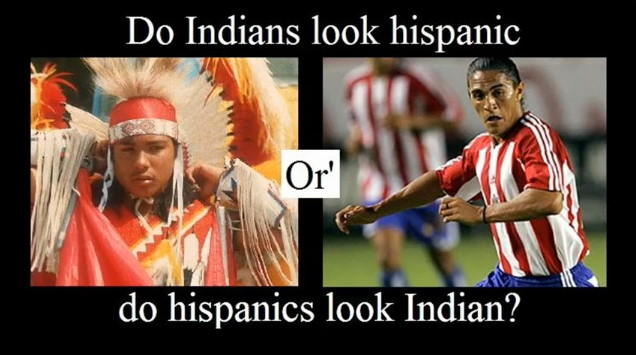
Do American Indians Look "Hispanic" or Do "Hispanics" Look American Indian?


srikrishnajay...

- There is a problem in the U.S. with the label Hispanic.
- The problem is people are redefining the term.
- The correct term for the label Hispanic; refers to those peoples of origin of Southern Europe. [Hispania]
- Here are some facts that can help you understand.
Hispanic is a term that goes back to the time of Romans [The true Latinos].
- Hispanic is someone of, from, or pertaining to the historical region of Hispania.
- Hispania is the name that Romans used to call the southern part of Europe, what is now "modern" Spain.
- From Hispania you get España.
- The Romans used the term Hispanus in Latin to refer those from Hispania (Spain).
- Hispanus is Latin for the Castilian (Spanish) word Hispano.
- In todays days now the term has changed and people are misusing this label, specially the U.S. Who considers "Hispanic " anyone who lives in the United States of "Latin America" Origin and can be of any Race, Black/African descent, White/Caucasian, Asian and/or Amerindian/Native American.
- The term of Hispanic in the United States is obviously wrong and Idiotic.

11.17.2009

The Sugar Cane Aguador "The Waterboy" -- Puerto Rico Circa 1944


Click the title link to see the full 116 photo "La Plata, Oct. 1944-Aug. 1947" collection by Dr. H. Clair Amstutz, a Mennonite medical missionary. These photos put images -- and in color -- to the stories told by our parents and grandparents.

11.13.2009

Frank Espada: The Puerto Rican Diaspora


“Frank [Espada]’s work is profoundly humanistic. Stereotypes about Puerto Rico and Puerto Ricans are so deeply embedded in mainstream U.S. culture that even some Puerto Ricans have started to believe them. Frank’s images dispel all that. He does it in a dignified way, yet without becoming sentimental or romantic.” [Pablo] Delano, Trinity College, Hartford

Photo: Paloma, Hartford, 1980
Source: The Puerto Rican Diaspora by Frank Espada

10.30.2009

Puerto Rico in the '40s

This lovely photo montage captures what my parents shared w/me and my siblings through stories, song and traditions about life on the island in the '40s. It's quite emotional for those of us of the Great Migration.

Also, I suspect many of our fellow Latino migrants--especially today's abused immigrant workers--can relate as well.

10.14.2009

Puerto Rico on the Edge

Even the harshest Republican governors on the US mainland aren't pushing for the mass firing of govt workers, but the one in Puerto Rico is. Gov Luis Fortuño has already fired 20,000 govt workers, including 7300 school teachers, and plans to fire another 10,000. This is on top of an island economy that leads the nation in unemployment and that shed 41,000 private sector jobs in the past year alone.

PR's unemployment rate now stands 17.5% -- again, by far the highest in the US and 2nd only to the Dominican Republic in the Caribbean. Oh, and the PR rate doesn't account for the under-employed nor for those who have given up hope of employment.

It's likely that 50- 60-70% of the island's workers are NOT gainfully employed—and prospects for such are exceedingly slim given the government’s boneheaded policies.

It's under this scenario that Fortuño's reckless firings, combined w/a military-style crackdown on protestors that's pushing PR over the edge. Though his response is not new...making life so miserable for workers that they migrate to the mainland is a well honed govt. strategy. Seriously, it's the classic San Juan approach to solving labor and economic challenges.

Watch tomorrow's island-wide strike. PR's future may very well depend on what the workers and the govt choose to do.